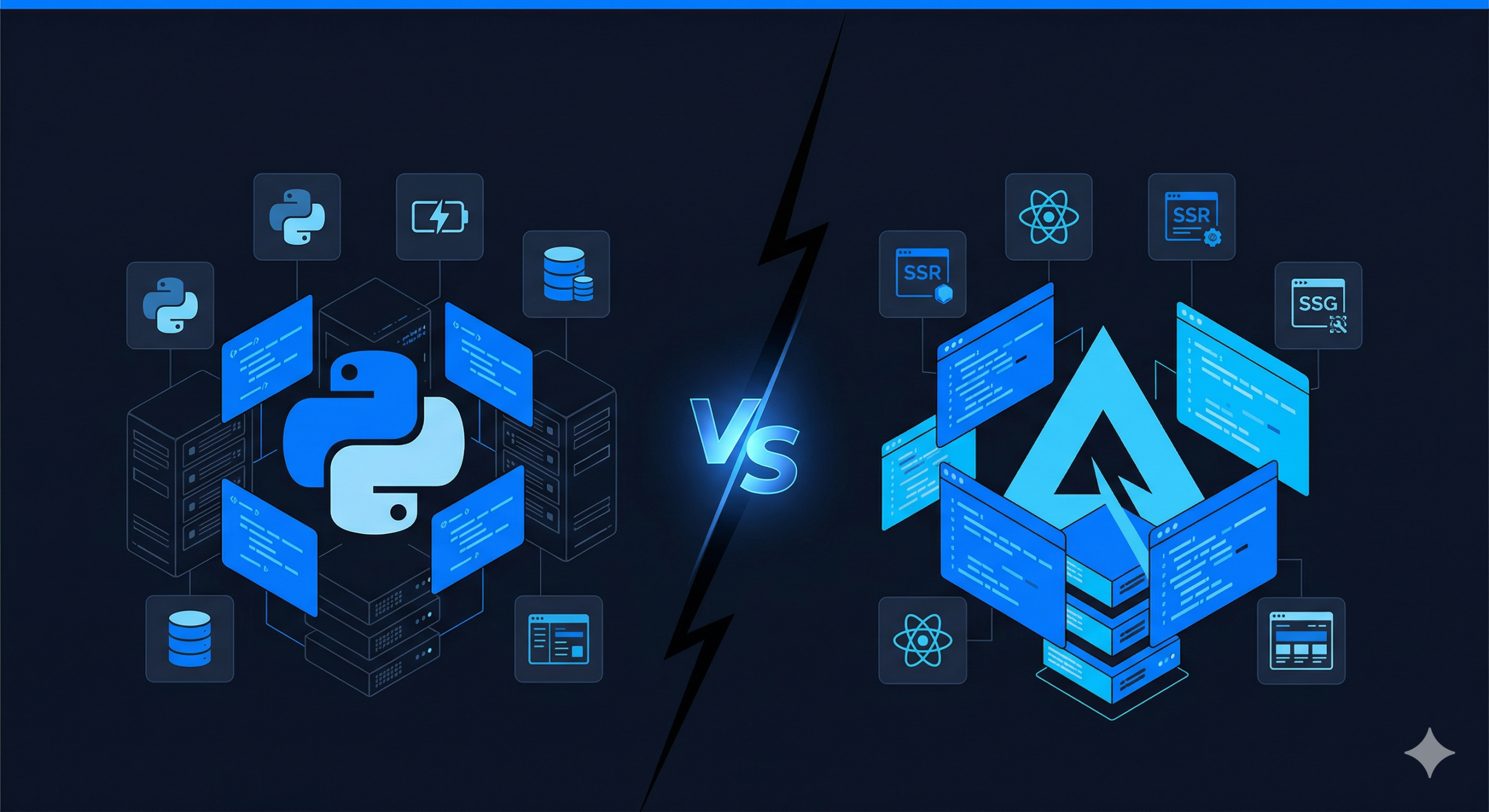
Choosing between Django and Next.js for building AI-driven SaaS applications in 2026 represents a fundamental
architectural decision that impacts development velocity, scalability, and long-term maintenance. This comparison examines
both frameworks through the lens of modern AI application requirements, including real-time inference, vector database
integration, WebSocket communication, and deployment complexity.
Architectural Philosophy and Core Design
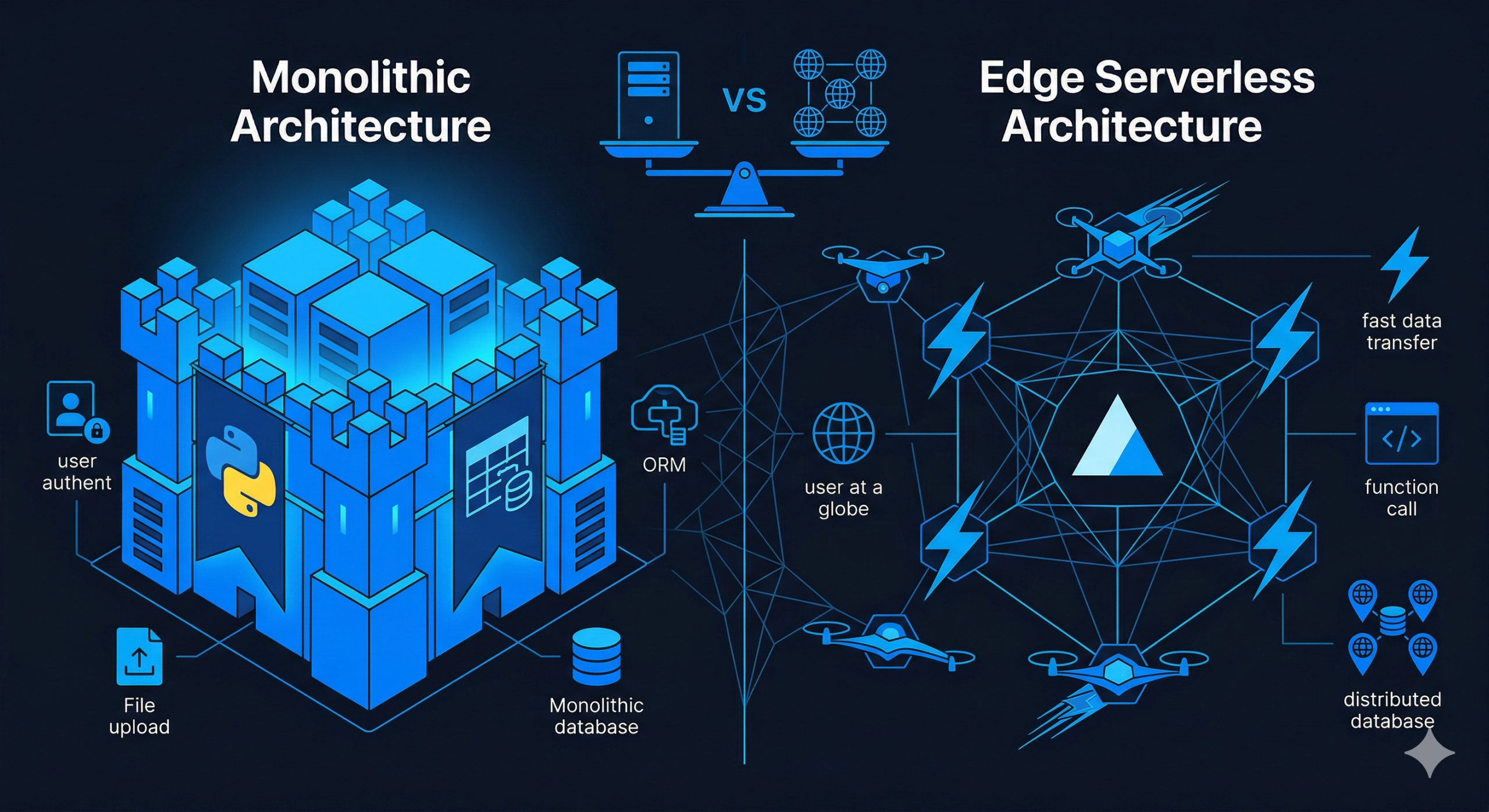
Django: The Monolithic Powerhouse
Django operates on a “batteries-included” philosophy with a monolithic architecture that provides everything from ORM
and authentication to admin interfaces out of the box. For AI-driven applications, Django’s synchronous request-response
model requires careful consideration when integrating with AI inference services that may have variable latency.
The Django Channels extension enables WebSocket support for real-time AI features, but this represents an additional
layer of complexity beyond Django’s core design. Django’s ORM provides excellent data modeling capabilities crucial for
managing AI training datasets, user interactions with AI features, and audit logs.
Next.js App Router: The React-First Edge
Next.js with the App Router represents a fundamentally different approach centered around React Server Components and
edge computing. The App Router’s file-based routing and server component architecture allow for sophisticated data
fetching patterns essential for AI applications.
Server Components can execute AI inference directly on the server without client-side JavaScript, while Client
Components handle interactive AI features. Next.js’s built-in API routes provide a clean separation between frontend
presentation and backend AI services, with the flexibility to deploy different routes to different environments (edge vs.
traditional server).
Performance Benchmarks and Scalability
Cold Start Performance
For AI-driven SaaS applications, cold start performance directly impacts user experience when AI models need to load
into memory. Django applications typically run on traditional servers with persistent processes, offering consistent
performance once warmed up but potentially slower initial response times.
Next.js on Vercel’s edge network demonstrates superior cold start characteristics, with Serverless Functions spinning
up in approximately 100-300ms. However, AI model loading times can negate this advantage unless models are pre-warmed or
cached at the edge.
Concurrent Request Handling
Django’s synchronous nature requires careful threading or process management (via Gunicorn/uWSGI) to handle concurrent
AI inference requests. Each request blocks a worker until the AI service responds, potentially creating bottlenecks during
peak usage.
Next.js Server Components and API routes operate in a serverless environment where each request can scale
independently. This architecture excels at handling burst traffic common in AI applications where users might
simultaneously request predictions or analyses.
Memory Management for AI Models
Large language models and computer vision models require significant memory allocation. Django applications running on
dedicated servers can maintain models in memory across requests, reducing inference latency but increasing infrastructure
costs.
Next.js serverless functions face memory limitations (typically 1-10GB on Vercel Pro) that restrict model size. This
necessitates external AI service integration or specialized deployment strategies for larger models.
AI Integration Capabilities
Real-Time AI Features
Django Channels provides WebSocket support for real-time AI features like chat interfaces with streaming responses. The
integration requires additional infrastructure (Redis for channel layers) but offers robust room-based messaging patterns
suitable for multi-user AI collaboration features.
Next.js supports real-time features through Server-Sent Events (SSE) and WebSockets via API routes. The App Router’s
streaming capabilities enable progressive rendering of AI-generated content, crucial for displaying partial results from
long-running inference tasks.
Vector Database Integration
Modern AI applications increasingly rely on vector databases for semantic search and retrieval-augmented generation
(RAG). Django’s ORM lacks native vector support, requiring custom field types and query extensions for databases like
PostgreSQL with pgvector.
Next.js applications typically interface with vector databases through dedicated API services rather than direct
database connections. This separation aligns with the serverless architecture but adds network latency to vector
similarity searches.
Model Versioning and A/B Testing
Django’s admin interface provides an excellent foundation for managing AI model versions and conducting A/B tests. The
framework’s permission system allows data scientists to deploy new models without engineering intervention, while Django’s
middleware can route traffic between model versions.
Next.js requires custom tooling for model management but offers superior experimentation capabilities through dynamic
routing and edge middleware. Vercel’s Edge Config and A/B testing features integrate seamlessly with the App Router for
gradual model rollouts.
Development Experience and Ecosystem
Python vs. JavaScript/TypeScript Ecosystem
Django benefits from Python’s dominant position in the AI/ML ecosystem. Direct integration with libraries like PyTorch,
TensorFlow, and Huging Face Transformers occurs within the same process, eliminating serialization overhead. Python’s data
science stack (NumPy, Pandas, SciPy) integrates naturally for data preprocessing pipelines.
Next.js applications written in TypeScript must communicate with Python AI services via HTTP or gRPC, introducing
serialization costs. However, the JavaScript ecosystem offers superior tooling for frontend AI visualization and
interactive model exploration through libraries like TensorFlow.js and ONX Runtime Web.
Type Safety and Developer Productivity
Django’s ORM provides excellent runtime type safety but lacks compile-time type checking. Python’s gradual typing with
mypy offers partial solutions, but refactoring large codebases remains challenging compared to TypeScript.
Next.js with TypeScript delivers end-to-end type safety from database queries (via Prisma or Drizzle) to React
components. The App Router’s type-safe file routing and data fetching patterns reduce runtime errors in complex AI
applications with multiple data dependencies.
Package Management and Dependency Isolation
Django applications face Python’s global package management challenges, particularly with AI libraries that have
complex native dependencies. Virtual environments and Docker containers mitigate these issues but add operational
complexity.
Next.js benefits from npm/yarn/pnpm’s superior dependency isolation and version management. Monorepo tools like
Turborepo enable sharing TypeScript types between frontend and AI service packages, crucial for maintaining consistency in
AI application interfaces.
Deployment and Infrastructure
Traditional vs. Serverless Deployment
Django deployments follow traditional server-based patterns requiring infrastructure management (load balancers,
auto-scaling groups, database connections). This approach provides fine-grained control over AI model deployment and GPU
allocation but increases operational overhead.
Next.js on Vercel offers zero-configuration deployment with automatic scaling and global CDN distribution. The
serverless model simplifies operations but restricts control over inference hardware and imposes execution time limits (up
to 60 seconds on Vercel Pro) that may constrain long-running AI tasks.
Cost Structure Analysis
Django’s server-based deployment incurs fixed costs regardless of traffic volume, advantageous for applications with
consistent usage patterns. GPU-equipped instances for local model inference represent significant expense but eliminate
per-request AI API costs.
Next.js serverless functions follow pay-per-execution pricing that scales with usage. This model benefits applications
with unpredictable traffic but can become expensive at scale, particularly for AI inference with high memory requirements
that trigger larger instance types.
Monitoring and Observability
Django integrates with traditional APM tools (Datadog, New Relic) that provide deep application performance insights.
Custom metrics for AI inference latency, model accuracy, and feature usage require additional instrumentation but benefit
from Python’s mature observability ecosystem.
Next.js on Vercel offers built-in analytics and performance monitoring optimized for the framework. Third-party
observability requires edge-compatible solutions that may lack the depth of traditional APM tools, particularly for
monitoring AI-specific metrics across distributed services.
Security Considerations for AI Applications
Input Validation and Prompt Injection
Django’s form validation and serializer system provide robust input sanitization crucial for preventing prompt
injection attacks in AI applications. The framework’s middleware architecture enables centralized security policies for AI
feature access and usage limits.
Next.js relies on TypeScript type validation and runtime checks in API routes. The framework’s edge runtime offers
built-in protection against common web vulnerabilities but requires custom implementation for AI-specific security
concerns like model poisoning detection.
Authentication and Rate Limiting
Django’s authentication system supports sophisticated permission models essential for tiered AI feature access. Django
REST Framework provides comprehensive rate limiting that can be customized based on AI model costs and user subscription
levels.
Next.js authentication typically relies on third-party providers (Auth.js) with varying levels of integration depth.
Rate limiting requires additional middleware or external services, though Vercel’s edge functions support geographic and
IP-based restrictions natively.
Future-Proofing and 2026 Projections
AI Hardware Acceleration
Django’s deployment flexibility allows integration with specialized AI hardware (GPUs, TPUs, AI accelerators) as they
become more accessible in 2026. The framework can leverage Python’s evolving hardware abstraction layers for optimal
performance across different inference targets.
Next.js’s serverless model depends on cloud providers’ AI hardware offerings. Vercel’s partnership with cloud GPU
providers may improve, but framework-level abstractions for hardware acceleration will likely remain less mature than
Python’s ecosystem.
Multimodal AI Integration
Django’s file handling capabilities and Python’s computer vision libraries provide strong foundations for multimodal AI
applications combining text, image, and audio processing. The framework’s background task system (Celery) efficiently
handles asynchronous processing of different media types.
Next.js excels at delivering multimodal AI experiences through responsive interfaces and real-time updates. The App
Router’s parallel routes and intercepting routes enable sophisticated UI patterns for applications that combine multiple
AI modalities in a single workflow.
Decision Framework for 2026 AI SaaS
Choose Django When:
- Python AI libraries require direct in-process integration
- Complex data pipelines involving multiple AI model chaining
- Fine-grained control over AI hardware and model deployment
- Established team with Python/Django expertise prioritizing backend complexity
- Regulatory requirements demanding on-premises deployment with specific security controls
Choose Next.js App Router When:
- Real-time AI interactions with streaming responses dominate the user experience
- Global user base requiring edge-deployed AI features with low latency
- Rapid iteration on AI-powered UI components and experimentation
- Modern development team comfortable with TypeScript and React patterns
- Variable traffic patterns benefiting from serverless scaling and cost models
Hybrid Approach Considerations
The most sophisticated AI-driven SaaS applications in 2026 may adopt hybrid architectures: Django for AI model serving
and data management, with Next.js frontends consuming these services via API. This approach leverages Python’s AI
ecosystem while providing modern user experiences, though it introduces distributed system complexity and network
overhead.
Emerging technologies like WebAssembly may blur these distinctions by enabling Python AI libraries to run in edge
environments, potentially allowing Next.js applications to execute complex inference directly without external service
calls.
The optimal choice depends on specific application requirements, team composition, and strategic priorities around
development velocity versus long-term scalability. Both frameworks continue evolving with AI-specific enhancements, making
ongoing evaluation essential as the AI landscape matures through 2026.
🏁 The Final Verdict: Which One for Your AI SaaS?
The winner isn’t universal; it’s situational. In 2026, the architectural gap has widened:
- Choose Django if: You are building a complex AI platform that requires deep in-process model management, heavy data processing with Pandas/NumPy, or specialized GPU orchestration. Django is your Heavy Artillery.
- Choose Next.js if: You prioritize User Experience (UX), rapid scaling, and a global edge presence. If your AI features rely on third-party APIs (OpenAI, Anthropic) and you want a seamless streaming UI, Next.js is your Fighter Jet.
The Pro Strategy: Most sophisticated AI-driven SaaS applications today adopt a hybrid architecture—using Django for the AI heavy lifting and Next.js for the high-performance frontend. But if you must pick one, choose the one that matches your team’s strongest skill set.