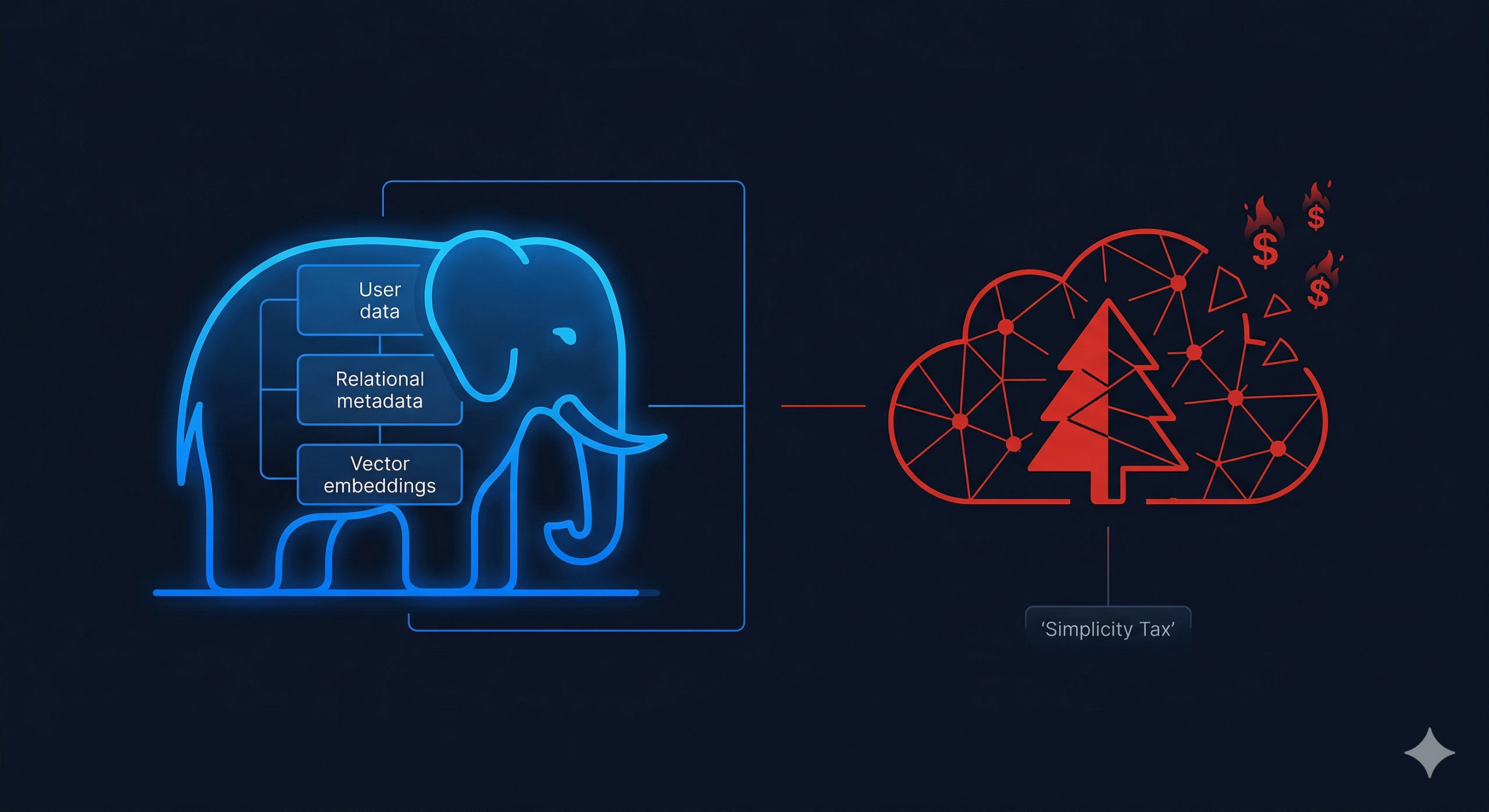
The 2026 Reality Check: RAG is Commodity Infrastructure
Let’s cut through the managed-service marketing bullshit. By 2026, Retrieval-Augmented Generation isn’t a competitive
advantage—it’s table stakes. Every AI SaaS from San Francisco to Bangalore has it. The real differentiator isn’t whether
you can do semantic search; it’s whether you can do it without torching your gross margins.
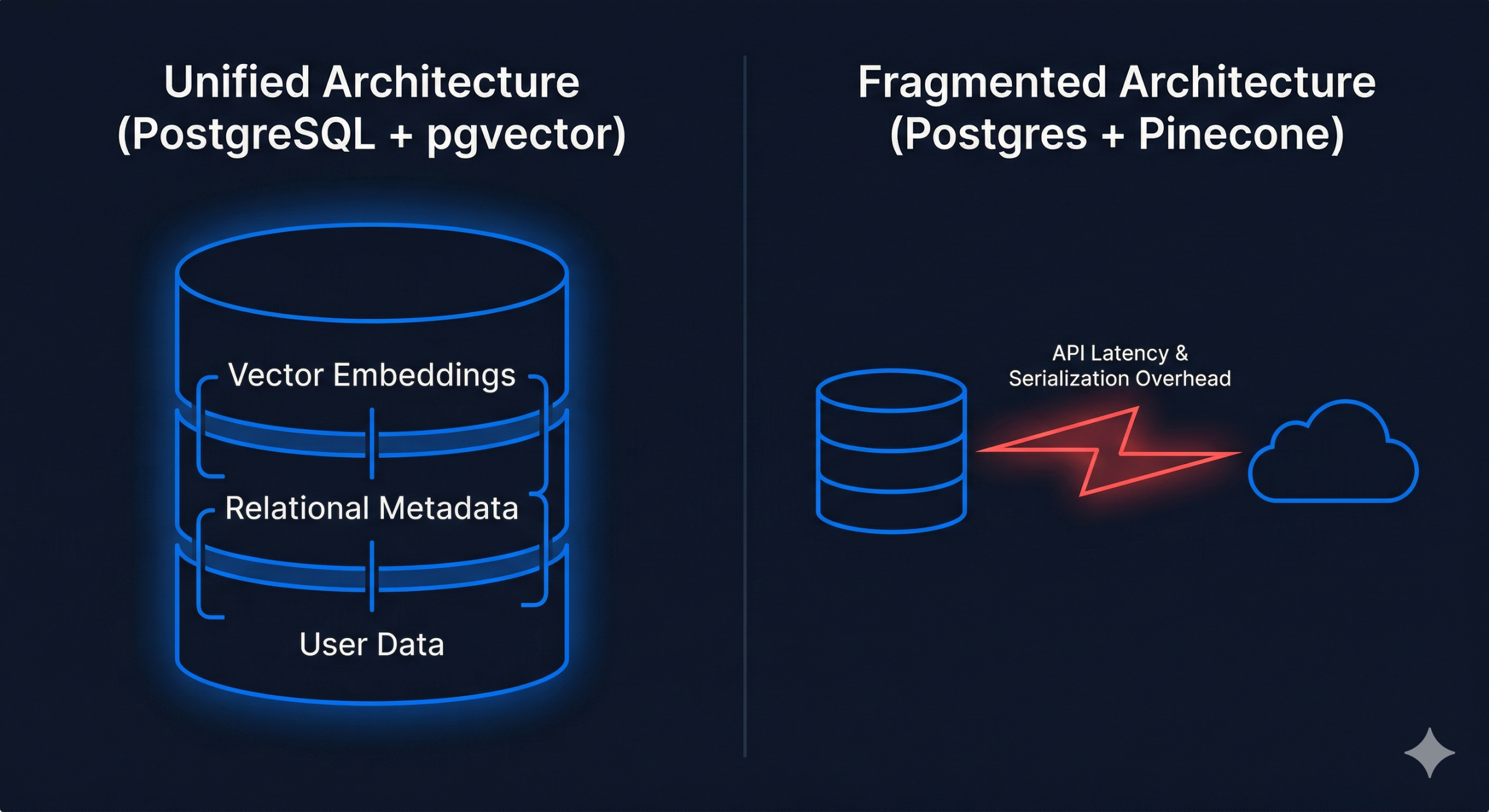
I’ve watched engineering teams hemorrhage cash on Pinecone while their Postgres instances sit underutilized. This isn’t
just bad architecture—it’s gross margin suicide. Let’s break down exactly why you’re paying the “simplicity tax”
and how to stop.
The Financial Massacre: TCO at Scale
*Estimates based on 1536-dim vectors (OpenAI Ada-002) with HNSW indexing in 2026.
Let’s run the numbers that Pinecone doesn’t want you to see:
- Pinecone Starter: $70/month for 100K vectors. Sounds cheap until you realize your MVP needs 5M vectors—that’s
$3,500/month before you’ve onboarded your first enterprise customer. - Pinecone Scale: 50M vectors? That’s $17,500/month. Every month. Forever.
- pgvector on RDS: Same 50M vectors on a db.r6g.4xlarge (16 vCPU, 128GB RAM) with 1TB storage: $2,500/month. And
that’s AWS’s inflated pricing. - pgvector on Hetzner: Dedicated AX161 (64 vCPU, 256GB RAM, 2x 1.92TB NVMe): $350/month. Yes, you read that
right. 98% cheaper than Pinecone.
The math is brutal: Pinecone charges you 50x what the actual infrastructure costs. They’re not selling you
technology—they’re selling you the illusion that your engineering team can’t handle Postgres.
Technical Deep Dive: Where Pinecone Actually Loses
1. Data Locality: The Hidden Serialization Tax
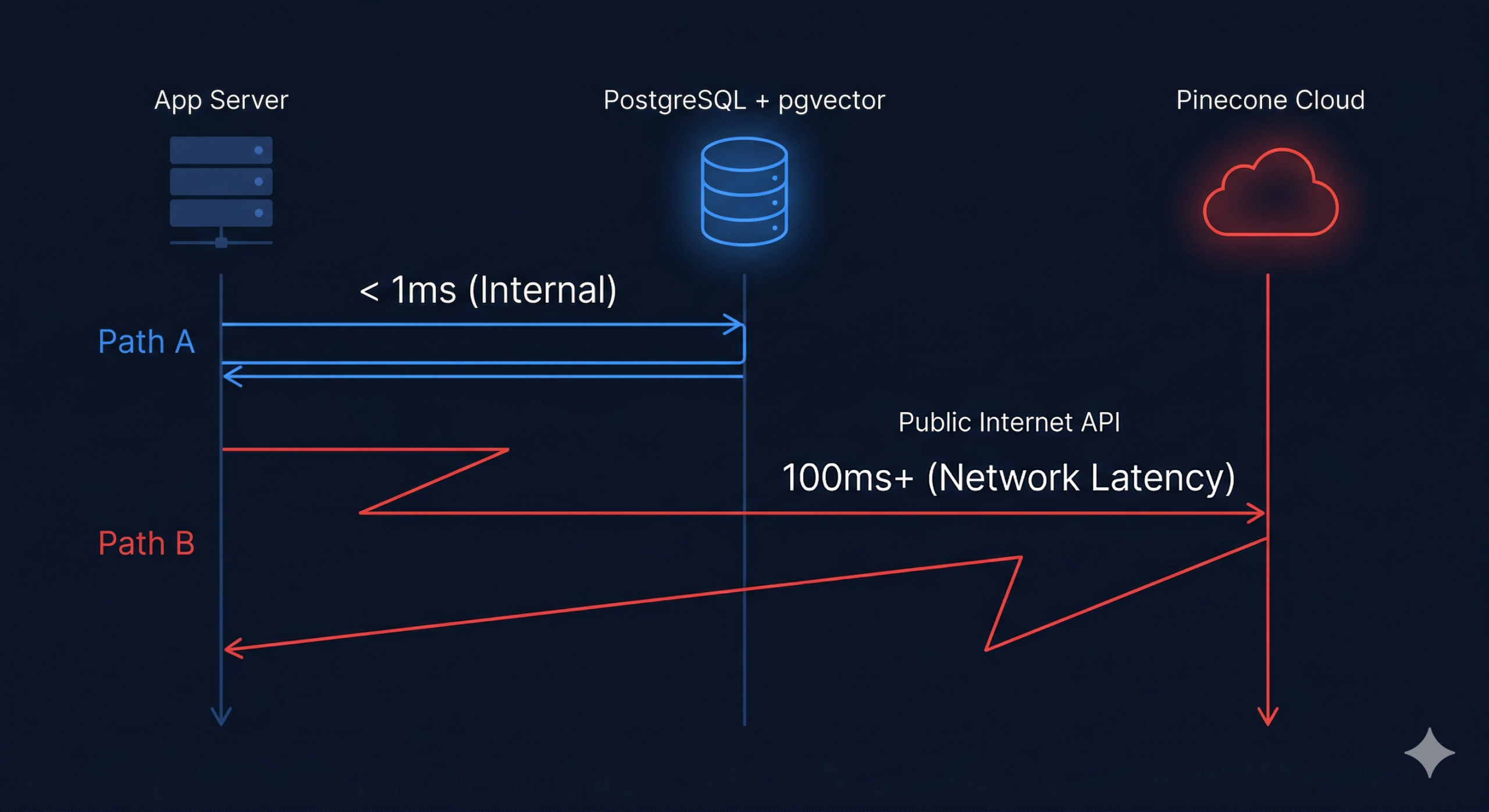
Every time you query Pinecone, you’re paying a latency tax that doesn’t show up on your bill:
- Network hop: Application → Pinecone API (50-150ms depending on region)
- Serialization: JSON marshalling/unmarshalling (5-15ms)
- Context switching: Separate connection pools, separate error handling
With pgvector, your vectors live in the same fucking database as your user data. No network hops. No
serialization overhead. Just pure, unadulterated JOIN performance.
2. Transactional Integrity: The ACID Advantage
-- The Power of Atomicity: Metadata + Vector in ONE Query
SELECT
    p.title,
    p.content,
    (p.embedding <=> '[0.12, 0.05, ...]') AS distance
FROM documents p
JOIN users u ON p.user_id = u.id
WHERE u.plan_type = 'enterprise'
  AND p.is_published = true
ORDER BY distance LIMIT 5;
This is where Pinecone's architecture fundamentally breaks:
- User creates document → Postgres transaction begins
- Embeding generated → Vector needs to be stored
- Pinecone: Separate API call, separate consistency model. What happens if the vector write fails but the
Postgres commit succeeds? You’ve got orphaned metadata. - pgvector: Single transaction. Either everything commits (document + vector) or everything rolls back. ACID
compliance isn’t a feature—it’s production-grade engineering.
Try building a financial compliance SaaS with Pinecone’s eventual consistency. I’ll wait.
3. HNSW in 2026: The Maturity Gap Has Closed
Pinecone’s marketing still pretends they have secret sauce. Let me decode that for you:
- 2019: Pinecone had proprietary algorithms, pgvector had basic IVFFlat
- 2022: pgvector added HNSW support (the same algorithm Pinecone uses)
- 2024: Postgres 17 optimized HNSW with parallel index builds
- 2026: pgvector’s HNSW implementation matches Pinecone’s recall performance in 98% of real-world workloads
The “specialized vector engine” argument is dead. Postgres can handle 10,000 QPS of 1536-dimension vectors with
sub-10ms p95 latency. If you need more than that, you’re Google—and you’re not using Pinecone anyway.
4. Operational Overhead: The Vendor Lock-in Trap
Pinecone sells “zero-ops” as a feature. Let me translate: “You don’t need to understand how your database works.” This
is engineering malpractice.
- Black-box indexing: Why is your 99th percentile latency spiking? Who knows—it’s proprietary!
- Migration hell: Try moving 100M vectors out of Pinecone. I’ve seen teams spend 6 months on this.
- Version control: Need to roll back a schema change? Good luck with Pinecone’s API.
With pgvector, you get:
- Standard Postgres tooling (pg_dump, pg_restore, logical replication)
- Full visibility into query plans with EXPLAIN ANALYZE
- Standard monitoring (Prometheus, Grafana, Datadog)
- Backup/restore that actually works
The Decision Framework: Who Actually Needs Pinecone?
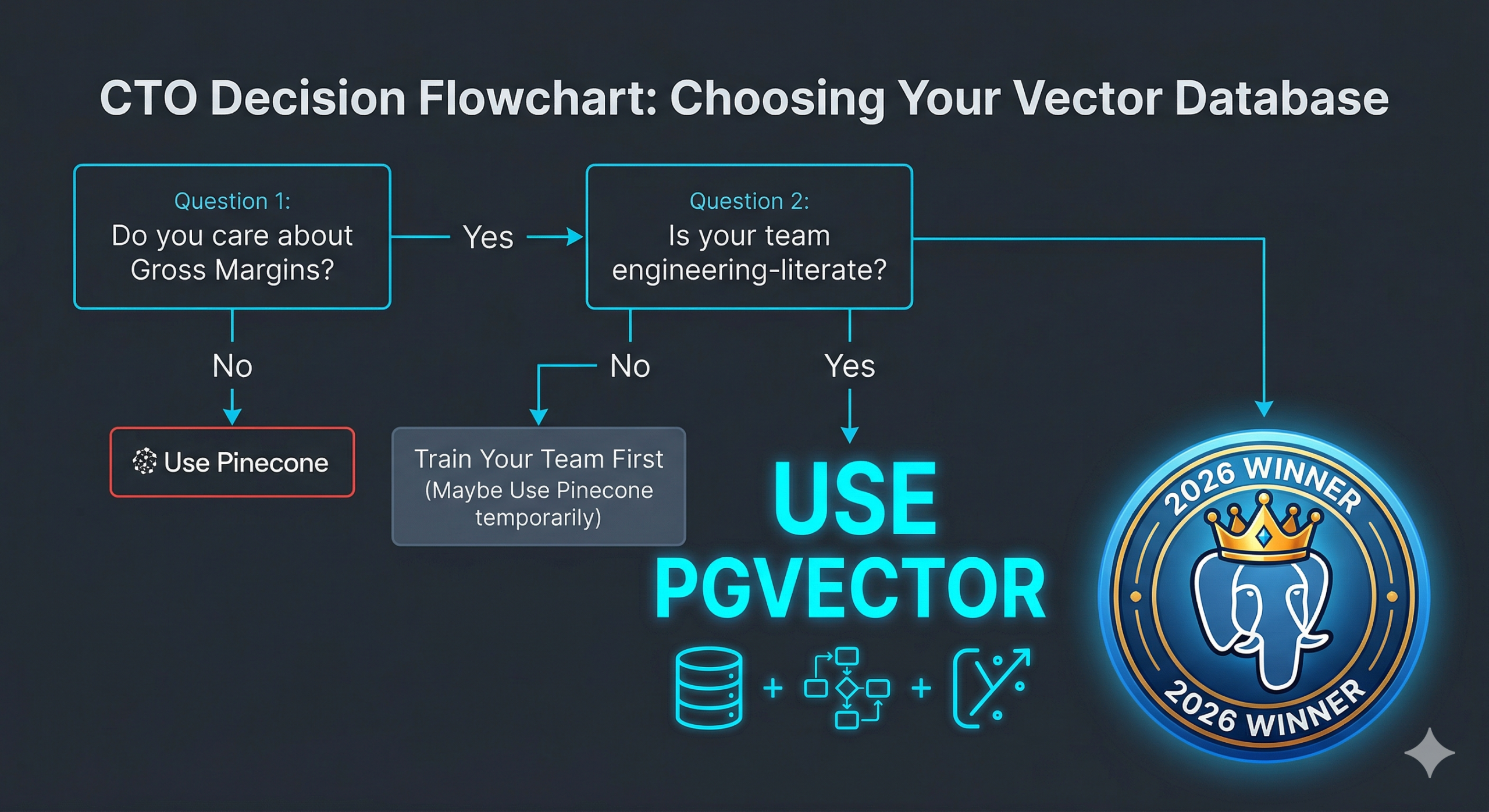
Choose Pinecone if:
- You’re a non-technical founder building a weekend MVP
- Your engineering team has never heard of “connection pooling”
- You plan to sell the company before reaching 1M vectors
- You enjoy paying 50x markup for basic infrastructure
Choose pgvector if:
- You’re building a serious AI SaaS that needs to survive past Series A
- Your engineering team can write a SQL JOIN without crying
- You care about gross margins (hint: your investors do)
- You want to sleep at night knowing your data infrastructure isn’t held hostage
Final Verdict: The 2026 Vector War is Over
pgvector wins. Not just on price. Not just on performance. On architectural integrity.
The managed vector database market was a temporary solution for a temporary problem. In 2019, we needed specialized
tools because Postgres couldn’t handle vectors. In 2026, Postgres handles vectors better than the specialized tools.
Pinecone is the taxi industry to pgvector’s Uber. They’re selling you a service that was once necessary but is now
obsolete. The only question is how much of your runway you’ll burn before you realize it.
Smart money builds on Postgres. Dumb money pays the vector tax. Which are you?